See EPCORE® NHL-1 study design for 3L+ DLBCL
See EPCORE® FL-1 study design for 2L+ FL
See EPCORE® NHL-1 study design for 3L+ FL

Select to learn about specific MOA functions
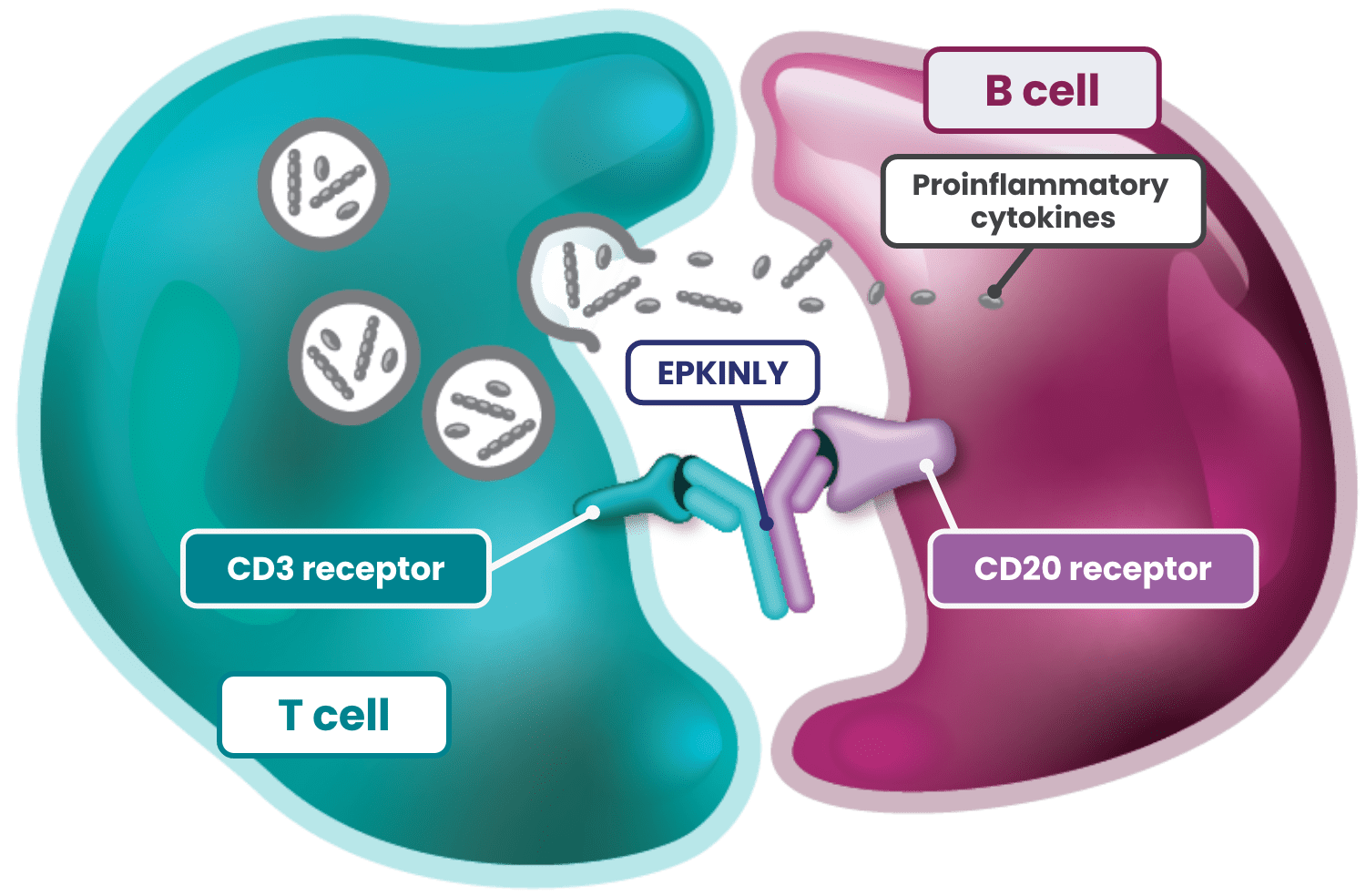
In vitro, EPKINLY activated T cells, caused the release of proinflammatory cytokines, and induced lysis of B cells.
EPKINLY binds to CD20 on B cells and to CD3 on T cells. CD20 is expressed on the surface of lymphoma and healthy B-lineage cells.
CD20 is expressed on the surface of lymphoma cells and healthy B‑lineage cells.
2L=second line; 3L=third line; CD3=cluster of differentiation 3; CD20=cluster of differentiation 20; DLBCL=diffuse large B-cell lymphoma; Fc=fragment crystallizable; FL=follicular lymphoma; IgG1=immunoglobulin G subclass 1; MOA=mechanism of action; NHL=non-Hodgkin lymphoma.
See EPCORE® NHL-1 study design for 3L+ DLBCL
See EPCORE® FL-1 study design for 2L+ FL
See EPCORE® NHL-1 study design for 3L+ FL
DLBCL and High-grade B-cell Lymphoma
Follicular Lymphoma
Please see full Prescribing Information, including Boxed Warnings.
07/2026 COM-US-EPK-0002864
References:
1. EPKINLY [package insert]. Plainsboro, NJ: Genmab US, Inc. and North Chicago, IL: AbbVie Inc. 2026. 2. Engelberts PJ, Hiemstra IH, de Jong B, et al. DuoBody-CD3xCD20 induces potent T-cell-mediated killing of malignant B cells in preclinical models and provides opportunities for subcutaneous dosing. EBioMedicine. 2020;52:102625. doi:10.1016/j.ebiom.2019.102625 3. Hutchings M, Mous R, Clausen MR, et al. Dose escalation of subcutaneous epcoritamab in patients with relapsed or refractory B-cell non-Hodgkin lymphoma: an open-label, phase 1/2 study. Lancet. 2021;398(10306):1157-1169. doi:10.1016/S0140-6736(21)00889-8